
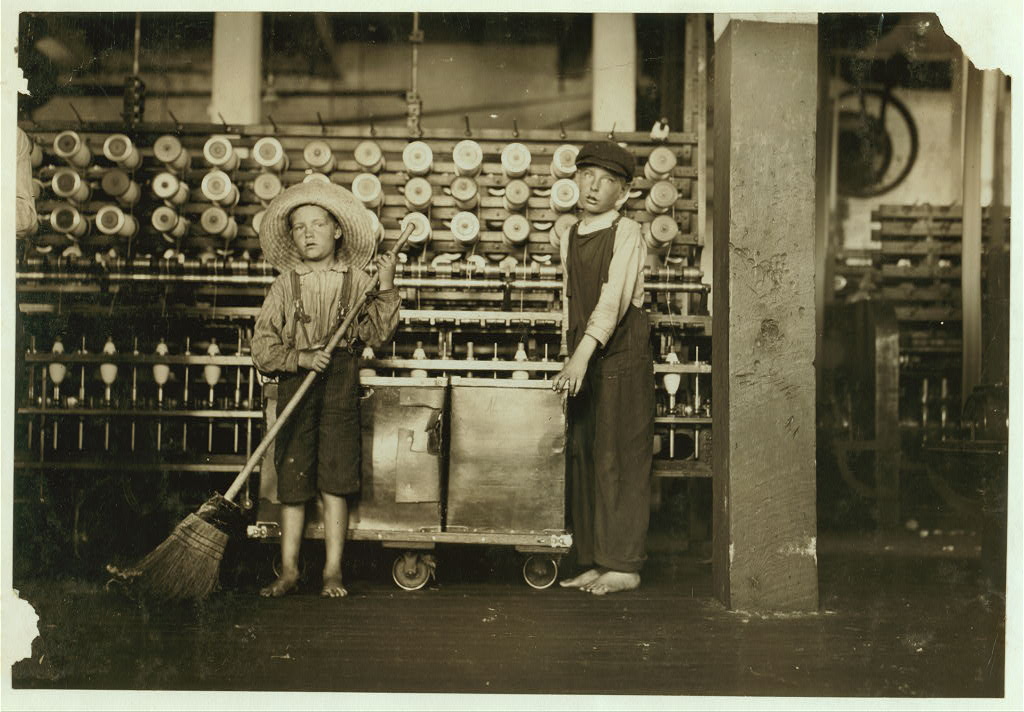
A doffer boy’s primary duty in 19th and early 20th-century textile mills was to remove full bobbins or spindles of spun cotton/wool from spinning machines and replace them with empty ones. This crucial, rapid job required high dexterity and speed over strength, with workers often operating barefoot to move quickly between machines during short bursts of intense activity.
Key Responsibilities and Context:
Doffing Process: When a whistle blew, indicating a machine was full, doffer boys rushed in to remove full bobbins and replace them with empty ones.
Intermittent Work: Doffing was often intermittent, allowing for rest periods between the rapid removal/replacement of spools.
Additional Tasks: When not doffing, boys often worked as sweepers, cleaning up cotton lint, or assisted in repairing broken threads.
High Danger: Children, sometimes as young as seven, worked around unguarded, moving machinery, often at high speed, leading to frequent accidents, such as losing fingers.
Job Progression: Doffers often started young and hoped to progress to more skilled, better-paid jobs, like spinning.
Doffer boys were essential for maintaining the continuous operation of spinning machines. They often worked in crowded, loud, and hazardous conditions, often under the gaze of photographers like Lewis Hine, who documented the young workers for the
National Child Labor Committee.
The below description and the image are from the Library of Congress
Ronald Webb, twelve year old doffer boy and Frank Robinson, seven year old who helps sweep and doff. Father is cardroom boss, Roanoke (Va.) Cotton Mills. Location: Roanoke, Virginia. Photo by Lewis Wickes Hine, 1911 May.
https://hdl.loc.gov/loc.pnp/nclc.02150